Quick Summary
Homeowners may first learn that something has changed around their property or mortgage through an ordinary letter, email, or account notice. In a recent New York Times report, an unexpected mortgage address-change confirmation prompted a homeowner to investigate whether deed theft could be involved and to examine ways homeowners can stay informed about property-record activity.
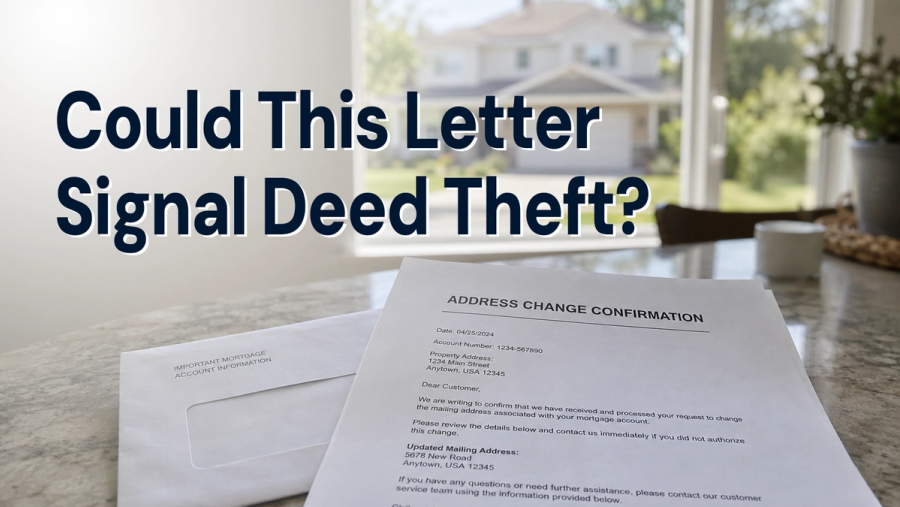
A homeowner returned from vacation to find a letter from mortgage servicer PNC Bank confirming an address change on a mortgage account. There was one problem: the homeowner had not requested the change. According to The New York Times, the unexpected notice immediately raised concern about whether a deed-theft scheme could be underway. The letter itself did not prove that a fraudulent deed had been recorded or that ownership of the property had changed, but it was enough to trigger questions about what had happened and whether anything else connected to the mortgage or property should be checked.
Key Point: An unexpected change involving a mortgage account may be easy to dismiss, but if the homeowner did not authorize it, the notice can be an important reason to verify what changed and review the property record.
The Times used the experience to examine what homeowners can do when they encounter unfamiliar notices connected to their home. The report discusses verifying the notice directly with the mortgage servicer, reviewing county property records and registering for free county deed-fraud notification programs where available. It also examines paid property-monitoring services. The broader lesson is easy to overlook: an unexpected address-change letter may look like routine mail, but when a homeowner did not request the change, it can be a reason to find out exactly what changed and why. In this case, an ordinary piece of mail prompted a much larger question: is something happening involving my home that I did not authorize?
This story was originally reported by The New York Times on August 30, 2026.
Full story: A Mortgage Servicer Sent a Letter About an Address Change. Was It Deed Theft? (Subscription may be required)
How This Type of Warning Can Unfold
1. An unfamiliar change appears
A homeowner receives a letter, email, alert or account notification about a change they do not remember making.
2. The homeowner verifies the notice
Rather than relying on the message alone, the homeowner can contact the institution directly using independently verified contact information.
3. Property records are checked
County land or recording records can help determine whether any documents involving the property have recently been recorded.
4. Unrecognized activity is investigated
A change does not automatically mean fraud. If the homeowner does not recognize it, additional research may be needed to determine what occurred.
5. Unauthorized documents require action
If a document was recorded without authorization, resolving the situation can involve the recorder’s office, lenders, law enforcement and legal professionals depending on the circumstances.